



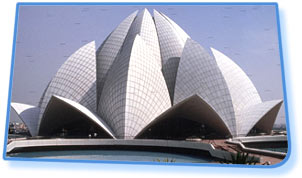
 Bahai faith represents the equality of mankind and oneness of its soul. The same feeling has been successfully transcended into the beautifully and scientifically degined Bahai Temple, designed by Fariburz Sahba, an Iranian-born Canadian architect, in shape of the lotus flower, symbol of purity throughout India and predominantly celebrates the number nine, which not only represents the highest digit but also unity in the Bahai faith. There are nine pools that have been constructed on the elevated platform signifying the green leaves of the lotus and also serves to cool the stark, elegant interiors of the structure. The delicate and
sleek architecture is built in two layers. The first layer consists of nine white marble-covered petals pointing towards heaven, while the second layer of nine petals serves to conceal the portals. When seen from a short distance, it looks like a fabulous example of origami work. The interior, especially, the Hall of Worship, conforms to that of all Bahai temples and is so silent that even a low whisper echoes loudly in the structure. No religious icons are housed here except the copies of the Holy Scriptures and wooden pews. The construction of the temple was
completed in 1986.
Bahai faith represents the equality of mankind and oneness of its soul. The same feeling has been successfully transcended into the beautifully and scientifically degined Bahai Temple, designed by Fariburz Sahba, an Iranian-born Canadian architect, in shape of the lotus flower, symbol of purity throughout India and predominantly celebrates the number nine, which not only represents the highest digit but also unity in the Bahai faith. There are nine pools that have been constructed on the elevated platform signifying the green leaves of the lotus and also serves to cool the stark, elegant interiors of the structure. The delicate and
sleek architecture is built in two layers. The first layer consists of nine white marble-covered petals pointing towards heaven, while the second layer of nine petals serves to conceal the portals. When seen from a short distance, it looks like a fabulous example of origami work. The interior, especially, the Hall of Worship, conforms to that of all Bahai temples and is so silent that even a low whisper echoes loudly in the structure. No religious icons are housed here except the copies of the Holy Scriptures and wooden pews. The construction of the temple was
completed in 1986.Birla Mandir or Lakshmi Narayan Mandir:
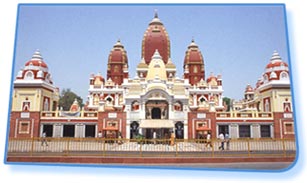 The temple has been erected bearing Nagara style of architecture intermingled with modern influences. The whole of the temple is festooned with relief carvings that depict the scenes from Indian mythology. Remarkable in its construction, 101 skilled by Acharya Vishvanath Shastri were imported from Benares (Varanasi) to carve the idols of the temple. The temple has a number of artistic sculptures and its highest Shikhara stands 160 ft high above the sanctum sanctorum aspiring to touch the blue skies above. The temple is situated on a high platform and faces eastwards. The main chamber of the temple is dedicated to Lord Narayan and His consort, Goddess Lakshmi. Other smaller shrines in the temple are dedicated to Lord Shiva, Lord Ganesha, Lord Hanuman, the Holy Vedas and also, Lord Buddha. The icons of the temple have been brought from Jaipur and are made in marble. The temple premises have been constructed in Kota stone brought here from Makarana, Agra, Kota and Jaisalmer. There are a number of miniature rock temples too that look like toy temples to children and attract them very much. An artificial landscape has been created complete with mountains and gushing waterfalls adding to the scenic beauty of the temple.
ISKCON Temple:
The temple belongs to the International Society for Krishna Consciousness (ISKCON) raised to propagate the message of the Bhagwad Gita by A.C. Bhaktivedanta Swami Prabhupada, the founder Acharya of the Hare Krishna movement. One of the 40 ISKCON temples in India, it is dedicated to the Lord Krishna. Completed in 1998, the temple is situated on a hilly region and was built by the followers of the Hare-Rama-Hare-Krishna cult. One of the largest temple complexes, the spotlight of the temple is the Robot, who enacts and preaches the holy text of the revered book of Hindua, the Gita.
The highest 'Shikhara' of the temple is 90-ft high and the hall of the temple is centrally air-conditioned. Full of aesthetic beauty, the temple has the statues of the two guards of 'Vaikunth' (the abode of Shri Krishna) at its entrance. The temple is adorned with some of the most beautiful paintings of Russian artists on the Hindu deities such as Radha Krishna, Sita, Ram, Laxman, Hanuman and Chaitanya Mahaprabhu.
Chhatarpur Mandir:
4 kms from Qutub Minar, Chhatarpur Temple is perhaps the most popular Hindu temples around Delhi. Far away from the city crowds, the vast premises of the temple have a blissful tranquil and serene ambience. Typically modern in its architecture, ample of marble has been used in its construction. The main sanctum sanctorum of the temple is dedicated to the Goddess Durga, while there are many shrines where you can worship Shiva, Vishnu, Lakshmi or Ganesha. It is believed that tying a thread or 'chudi' (a bangle) on a tree situated in the temple fulfils the wishes of the devotees. It is customary to wash one's feet and hands and rinse the mouth with water from the tap just outside the entrance of the temple before entering it. There are especially large numbers of people who turn around here during Durga Puja days to offer prayers. Round-the-clock discourses and prayers are held in the temple precincts where devotees can partake freely.
Bala Hanumanji Temple:
This elegant temple standing on the southeast of the Lake Ranmal Lake has earned a place in the Guinness Book of Records because of the continuous 24-hour chanting of the mantra 'Sri Ram, Jai Ram, Jai Jai Ram' since August 1, 1964, without any break.


